
Design · 5 min read
Building a Design Handbook That Actually Works
Why your brilliant ideas from your last company might be sabotaging your new team and what I've learned about doing it differently.
You know that urge to pull out your old playbook when you step into a new design leadership role? I’ve felt it too: ignoring failed strategies, carrying proven approaches from past companies, only to watch them fall flat. It turns out those solutions, solid as they seemed before, often clash with the new environment. They can even push your team away if you force them on your team.
Over several roles, I’ve shifted my thinking, focusing instead on understanding what the current workplace environment stimulates or represses before building anything.
This helps create strategies that stick because they’re born from the team’s reality, not just my past wins.
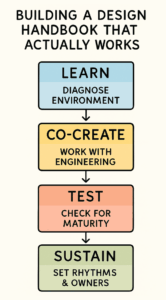
Ditch Your Solutions (For Now) and Learn the Landscape
Start by setting aside what worked elsewhere. Environments can either support design efforts or quietly undermine them, much like how certain conditions nourish basic human needs while others block them. In organizations, this might mean spotting patterns that help or hinder team behaviors right away.
When starting a new role, I suggest kicking off with a focused workshop, bringing in your design team and folks from engineering or product, if you can. The aim is to map out how design really functions here, what boosts it, and what drags it down. Sure, some places balk at the time commitment, but I’ve found this early step saves headaches later, avoiding months of misfires. In a pinch, like at a startup in crisis mode, shorten it to a few hours spread out over time. Even that bit of diagnosis builds a stronger base than jumping straight to solutions.
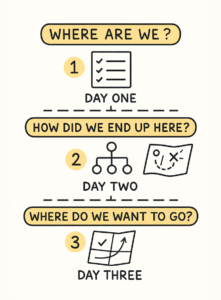
Day One: Where Are We?
Don’t dive into big visions yet. Begin with the everyday hurdles. When I led the EIS Design team at Meta, we mapped trust flows and pushback between groups, asking things like: How does engineering usually react to design ideas? Where do real product calls happen? What sank the last design push, and why? Who holds informal sway? These questions often uncover raw truths about the org. It can feel a bit uncomfortable, but it’s key to seeing the landscape clearly.
Day Two: How Did We End Up Here?
Next, trace back how things got this way. Past choices can lock in paths that make some changes easy and others tough, shaping future behaviors in subtle ways. We dig into decision histories, failed tries from before, and outside pressures like market shifts.
This helps explain stuck conversations or tense ties. It’s not always easy, but I’ve seen it give teams the context they need to move forward without repeating old mistakes.
Day Three: Where Do We Want To Go?
By this point, something shifts. Teams start spotting their own needs, rather than waiting for you to dictate. Wrap with a shared map of the now, the past, and the hoped-for future. Set commitments across short, mid, and long terms: quick wins in 30 days, solid shifts in a year, deeper changes over three.
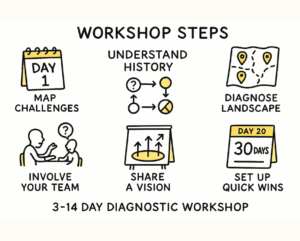
At Meta, this birthed our first EISA Design & Research handbook, tailored to our setup, with strategy, goals, and measures co-created across teams. It had real buy-in because it grew from that group work.
Making Design Part of the Engineering Solution
Design Handbooks flop when they’re designer-only affairs shoved down others’ throats. Try a collaborative tack instead. At Meta’s engineering-heavy culture, we led with that on page one, positioning design as a front-end boost to engineering. Not perfect, maybe, but it fit and worked. Seek allies in product and engineering early; you need at least one per group who sees design’s wins as theirs too. If they’re missing, that signals you might build basics first, like ties, before processes.
Your Design & Research Handbook should hold agreed roles in the bigger system:
- Success markers that click for everyone, not just design.
- Processes respecting real limits, like deadlines.
- Communication that matches how others operate.
- Ways to update it as things change.
Proven methods travel, but how you apply them varies. User research helps anywhere, yet its form, from formal ops to quick embeds, depends on the spot.
Test the Waters First
Before going big, gauge maturity. In a hierarchy where design serves others, focus your handbook on tactics: delivering credible work, backing choices, growing influence bit by bit.
Probe with sharp questions: Does leadership buy the value? Can partners handle new ways of working, or are they swamped? What pressures, like cuts or reorgs, might derail? Do you have the clout?. Keep it alive and avoid bureaucratic traps in implementing new strategic ideas.
I’ve seen others morph into burdens that consume time without real returns. To prevent that, link reviews to business cycles, designate owners for sections, log divergences between docs and practice, and measure with clear, shared metrics. Zooming out, this keeps the handbook as a living tool that adapts organizational behaviors, not a static artifact.
I focus on cultivating conditions where design flourishes naturally, then document what emerges. If a full strategic handbook risks bureaucracy, opt for lighter alternatives, such as shared wikis or quick-start guides. In environments that suppress collaboration, even solid docs gather dust.
This diagnostic mindset has sharpened my leadership, ensuring ideas take root in context.
No matter if you’re entering a mature org or bootstrapping design, it clarifies precisely what to capture and whether a handbook serves the team’s future at all.
References
- Ezio Manzini — Design, When Everybody Designs
- Cameron Tonkinwise — Designing for Transitions
- IDEO — Designing Organizations for Change
- Nielsen Norman Group — UX Maturity Models
- Harvard Business Review — Why Change Programs Don’t Produce Change
- Don Norman — The Design of Everyday Things