Design · 7 min read
Tetrahedral Model: Building Stronger Ties in Product Teams
A Systems Model for Cross-Disciplinary Coordination
I’ve been reflecting on how the key to strong product organizations often lies beyond just assembling talented people. It’s about the quality of interactions- how people connect and interact within the work environment. Often, as leaders, we pour energy into building strong teams in Product, Engineering, Design, and Research, and that makes perfect sense, since skills drive results. But even with sharp individuals, you might not get a cohesive group. The connections between departments, those unpredictable exchanges, appear to hold the true potential, though they can feel chaotic at times.
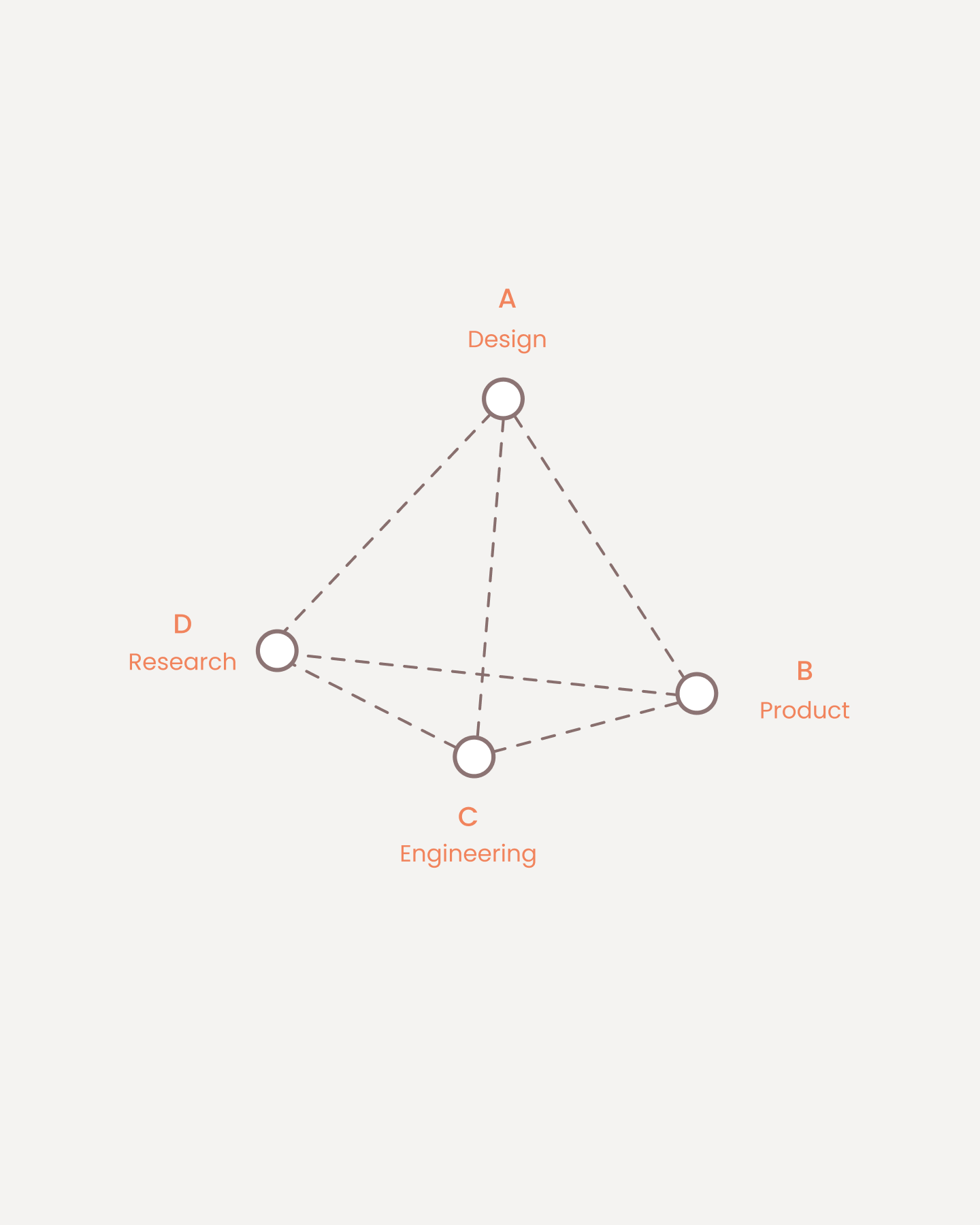
Let me share what I call the Tetrahedral Product Organization (TPO) model. This framework draws lightly from systems thinking, where stable setups rely on linked parts that adapt together. The focus isn’t so much on the four main elements, but on the six links between them.
These ties handle information sharing, teamwork, and problem-solving, which can either strengthen or undermine the whole.
As a leader, you could use this view to shift from rigid silos toward a setup that anticipates tensions, fosters common goals, and builds ties that drive real product advances. Zooming out, this approach might reshape team behaviors at scale, influencing how organizations transition toward more adaptive futures.
Where Does This Come From?
The tetrahedral shape from systems thinking offers a simple way to map key ties in groups. Think of Buckminster Fuller’s idea: it’s the basic 3D form that stays solid and defines clear boundaries. Instead of viewing departments as separate, this lens highlights their coordination.
Fuller noted that stable systems need at least four points to separate inside from outside, creating conditions for internal strength and external response. In practice, this breaks down into:
Nodes: These are steady parts that evolve slowly, like core roles in product work, each with its own ways, measures, and cultures.
Synergies: The active links between nodes, which shift quickly based on how people communicate and work together. You can adjust these through daily changes, unlike the nodes themselves.
Fields: Areas that pop up when three nodes connect, sparking fresh ideas that no single group could create alone.
The Void: This is the built-up wisdom and gut-level choices that come when everything else clicks.
This setup reminds me of models like the Tetrahedral Model of Performance, where personal, group, and company levels meet cultural bases.
The Six Synergies That Make or Break Teams
In product settings, the four nodes line up as:
- Product Management: Handling strategy, needs, and market checks.
- Design: Covering User experience research, interface design, and usability testing.
- Engineering: Technical architecture, implementation, system performance.
- Research: Digging into user behavior analysis, market validation, and evidence generation.
These form your base, changing gradually. These nodes form your stable foundation, the core competencies that change slowly and resist disruption.
But the six synergies? That’s where things get interesting, or fall apart.
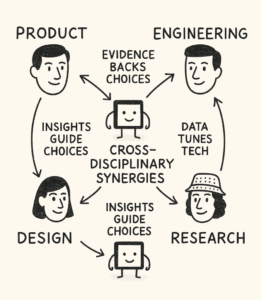
Product to Design: Strategy and user experience inform each other. Business goals align with user needs. When it doesn’t, design becomes decorative. Strategy ignores user experience. You end up with feature factories.
Product to Engineering: Reality shapes plans. Technical feasibility shapes strategic decisions. Roadmaps reflect engineering realities. When it doesn’t, engineering becomes an order-taking function. Technical debt accumulates from unrealistic timelines.
Product to Research: Strategy gets backed by evidence. Market insights drive product decisions. When it doesn’t, research becomes confirmation bias. Data gets cherry-picked to support predetermined strategies.
Design to Engineering: Technical constraints inspire creative solutions. Implementation enhances design intent. When it doesn’t, you get “Design vs. Engineering” battles. Solutions that look good but perform poorly, or engineering solutions users don’t use.
Design to Research: User insights directly inform design decisions. Design solutions get validated with real users. When it doesn’t, research becomes a post-hoc justification. Design based on assumptions rather than evidence.
Engineering to Research: Technical decisions are informed by user behavior data. Performance optimization driven by usage patterns. When it doesn’t, engineering optimization happens in isolation. Technical metrics disconnected from user impact.
When Things Go Wrong
What concerns me is how often bad links go unnoticed. Teams might seem okay, with meetings and outputs flowing, yet underlying issues erode trust over time. I’ve noticed signs like one-way info flows, say, Research feeds Product but skips Engineering. Or blame-filled talk, like “They can’t build it” instead of joint exploration. Groups tackle similar issues alone, metrics clash without links, disputes settle by rank, not facts.
These can lead to a strategy without user input, creating usable but aimless features. Or designs that please but miss goals. Tech choices ignore behavior, optimizations drift from impact. Quality comes from push-pull, not team-ups. It’s not always clear-cut; sometimes a strong link in one area masks weaknesses elsewhere, but addressing them early prevents bigger rifts.
Building Better Connections
Fixing bad “links” doesn’t mean redrawing your structure. Focus on practices that boost links.
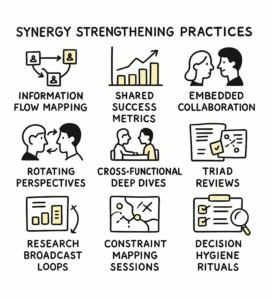
Design Information Flow: Chart how knowledge moves. Does research reach all? How do tech hurdles hit Product? Strong setups act like smart info hubs.
Share Metrics: Tie success across groups. The product might track user joy from Design and Research. Engineering could watch use-based speeds.
Set Rituals: Beyond weeklies, try pair-ups, reviews, and deep dives needing multiple inputs.
Rotate Views: Embed folks briefly. Product shadows research, Engineers join critiques, Designers see data.
Spot Issues: Use retros on ties; provide feedback on blocks.
The Fields: Where New Things Emerge
Get synergies right, and fresh zones appear from three-way ties. Product, design, and engineering might uncover technical fixes for user pain points. Design, research, and engineering spots build chances that research alone misses. Product research and engineering identify markets that need new tech.
These areas hold your edge, the spots where linked work breeds novelty. Though not every triangle yields gold right away, nurturing them builds resilience.
A Practical Starting Point: The Synergy Audit
To try this, start simple with an audit:
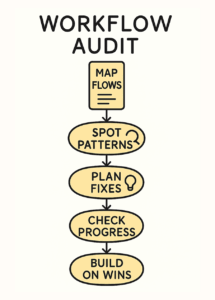
Map flows: Track current information flows and their movement between nodes. How does information currently move between Product, Design, Engineering, and Research?
Spot negative patterns: Look for blame, clashes, and misfits. Where do you see defensive language, escalated conflicts, or misaligned metrics?
Plan fixes: Pick practices for weak spots. Design positive interventions. What specific practices could improve the weakest links?
Check progress: Measure if changes help. Create feedback loops. How will you know if your interventions are working?
Build on wins: Iterate and strengthen. Grow strong links, watch weak ones. Which positive links can you amplify? Which negative ones need continued attention?
Beyond Process: The Mindset Shift
I’ve found that the real power of this tetrahedral model lies in how it reframes what we prioritize as leaders. It’s not just about refining processes or adding more meetings; it’s about cultivating a mindset that values the spaces between disciplines as much as the disciplines themselves. You start by recognizing that exceptional product work emerges from these interconnections, where tensions become opportunities for shared understanding rather than roadblocks.
This shift means moving away from optimizing individual roles in isolation, toward designing conditions that let Product, Design, Engineering, and Research thrive together.
In my experience, that often involves acknowledging trade-offs, such as short-term efficiency for long-term resilience in team behavior. Zooming out, this isn’t merely operational; it participates in transitioning your organization toward futures where adaptability is baked into the culture rather than bolted on.
To make it stick, examine your own patterns first. How do you, as a leader, model these synergies in your daily decisions? Start small: Track a week’s worth of cross-team interactions in your group. Note where collaboration flows naturally and where isolation creeps in. Those observations will reveal practical entry points, without overwhelming your team. The goal isn’t perfection, but steady progress toward a system where connections drive not just better products, but healthier, more sustainable ways of working. With patience, you’ll see how these subtle changes build momentum, creating an organization that’s equipped for whatever comes next.
References
- Buckminster Fuller — Synergetics
- Donella Meadows — Thinking in Systems
- Cameron Tonkinwise — Designing for Transitions
- IDEO — Designing Organizations for Collaboration
- Harvard Business Review — The New Science of Building Great Teams
- Nielsen Norman Group — Cross-Functional Collaboration in Product Teams